Winter Dog Walks: Five Rain Coat Problems and How to Fix Them
Winter dog walking breaks rain coats in ways ordinary use does not, because you are outside twice a day regardless of weather, one hand is occupied, and something wet and muddy is moving around your legs. The five recurring problems are cold hands, a soaked lead arm, spray from a shaking dog, a hood that cuts your hearing near roads, and a coat that never dries between walks. Each has a fix that takes seconds once you know it.
Problem 1: cold hands, because pockets are doing two jobs
The pocket that holds your keys, phone, and bags is also the pocket you want your free hand in. In winter those two uses conflict, and the hand loses. You end up holding a phone and a lead with wet, cold fingers and nothing in reserve.
The fix is to dedicate the pockets before you leave. Put keys, phone, and everything else in one zippered pocket and leave the other one completely empty as a hand pocket. Two deep zippered pockets make this workable because the loaded pocket stays closed and nothing falls out when you bend down.
Second part of the fix: snap the cuffs closed before your hands get cold. An open cuff on a windy walk funnels cold air up the forearm, and once your forearms have chilled your fingers will not warm up again for the rest of the walk. Cuffs are a hand-warmth feature more than a water feature in winter.
Problem 2: the lead arm gets wet first
Photo by Roxy Svydovetska on Pexels
Whichever arm holds the lead is held out from your body, bent, and moving. That sleeve takes more rain than the other one, and the wrist is the point of entry: a bent elbow shortens the effective sleeve length and exposes the gap between cuff and glove.
- Snap the cuff on the lead arm even if you leave the other one open. It closes the gap at the wrist where water runs down and in.
- Wear the glove cuff over the coat cuff, not under it, so water runs off rather than into the glove.
- Swap hands at the halfway point on long walks. It sounds trivial; it halves the exposure on each arm and gives one hand a chance to recover in a pocket.
- If you use a waist-worn or cross-body lead, run it under the coat rather than over it. A lead over a closed coat pulls the front open at exactly the point rain runs off.
Problem 3: the dog shakes and you get sprayed from below
A dog shaking off water directs a dense spray of dirty water upward and outward at knee-to-hip height. This is the single dirtiest event on a winter walk, and it is why coat length matters more than most dog owners assume.
A long coat intercepts the spray on a waterproof surface that wipes clean. A short jacket sends all of it onto your trousers, which then stay wet and cold for the remainder of the walk and take hours to dry. The same applies to splashback from your own boots on a wet path, which lands in the same zone.
Two habits help. Let the shake happen at arm's length rather than beside you, and let the mud dry before cleaning it. Wet mud smears across a wider area when wiped; dried mud brushes off a smooth waterproof surface with a hand.
Problem 4: a cinched hood cuts hearing and side vision
A drawstring hood pulled tight in wind and rain restricts side vision and muffles sound. On an open field that is harmless. Near a road, on a shared path with cyclists, or anywhere you need to hear a car approaching from behind, it is a genuine hazard, and it is why some people give up on hoods entirely.
The answer is two hood settings rather than one. Cinch it down on exposed stretches where you are walking into wind and looking ahead. Loosen it by an inch or two near roads and junctions so you can turn your head inside the hood instead of turning the hood with your head. An adjustable drawstring lets you make that change in a second without stopping, which is what makes it practical rather than theoretical. If you want a fuller walkthrough of the settings themselves, how to adjust the waist, hood, and cuffs covers each one.
The related failure is a hood that collapses or fills with water in real wind, which is a design problem rather than an adjustment one. Why minimalist rainwear hoods fail in a storm explains what to look for.
Problem 5: two walks a day and the coat is never dry
This is the problem that actually causes people to buy a second coat. A coat that comes home wet at eight in the morning and has to go back on at five in the afternoon has nine hours to dry, which is enough only if you hang it properly. Left in a heap by the door, or hung folded over a bannister, it will still be damp and it will start to smell within a fortnight.
| Problem | Quick fix at the door | Longer-term fix | |---|---|---| | Coat still damp for the second walk | Hang open on a wide hanger, cuffs unsnapped, hood spread, zip open | A hook with airflow rather than in a closed cupboard | | Musty smell developing after a few weeks | Turn pockets out and air overnight before the next walk | A cool wash with plain detergent and a full open air-dry | | Wet gloves left inside a zipped pocket | Take them out every single time | Keep gloves in the same pocket every walk so it is habit | | Mud dried into the cuff snaps | Flex each snap open and closed once dry | Rinse the cuff area under a cool tap when you rinse the hem | | Salt marks on the hem after gritted pavements | Rinse the lower panels with cool water | A cool wash before the coat gets put away for spring |
The two habits that matter: hang it open with airflow, and never zip a wet coat closed to dry. A closed coat traps damp against the lining, which is the part that touches you.
Being seen on a dark walk
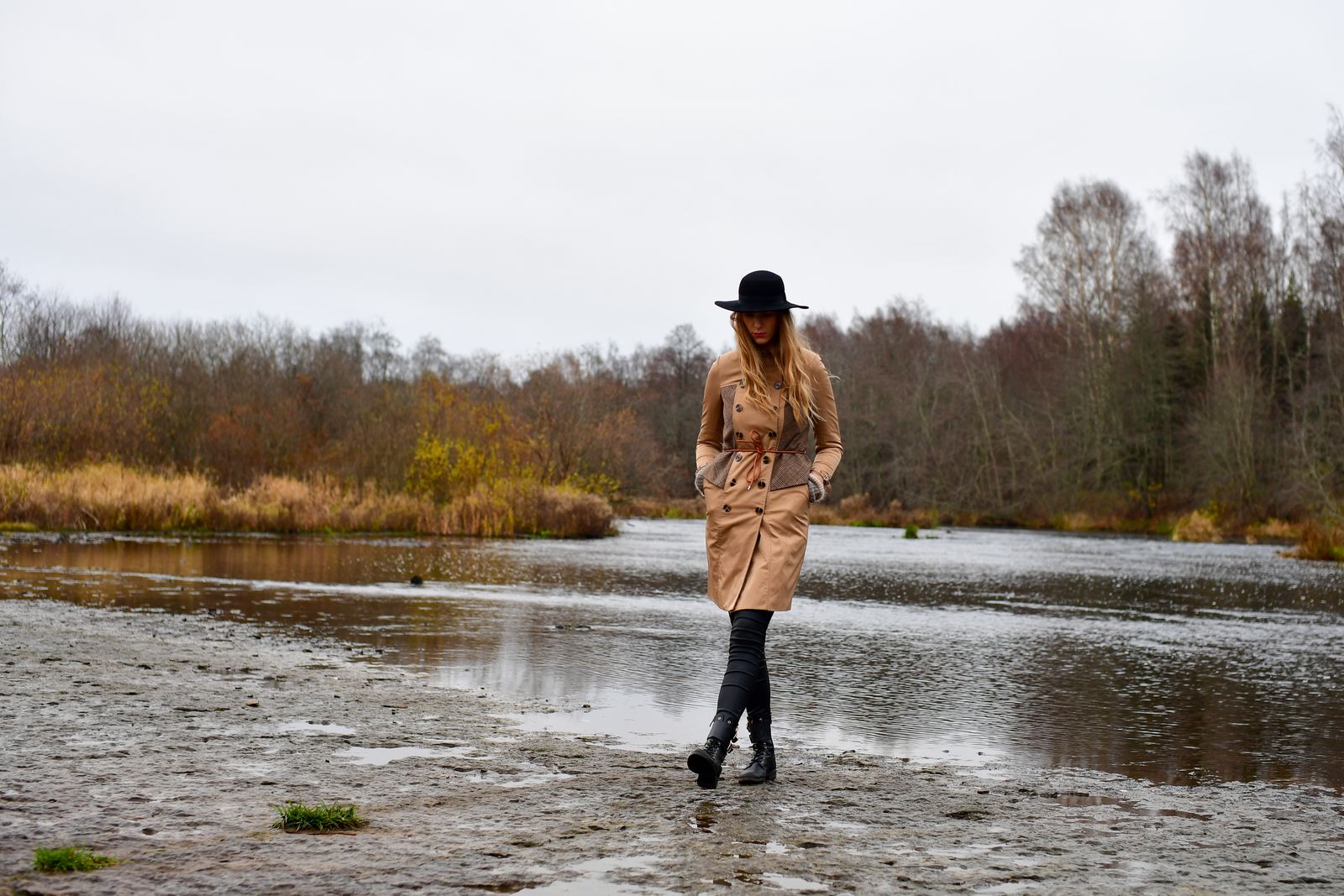
Photo by Margo Evardson on Pexels
Winter dog walking happens in the dark at both ends of the day, and a dark coat on an unlit path is a real problem. The coat is not a safety device, so treat visibility as a separate item: a reflective band, a light clipped to the coat or the lead, and a light on the dog's collar. If you are choosing a coat and any part of your route is roadside, a lighter tone is worth considering for that reason alone. Weigh it against how well a mid-tone hides splashback and mud, which is the competing consideration for the same garment.
Winter care that keeps the coat working
- Rinse the lower panels and hem with cool water after walks on gritted or salted pavements. Salt left on fabric is more damaging than mud.
- Let mud dry before removing it, then brush rather than scrub. Grinding grit into fabric is what causes wear.
- Check the snap cuffs monthly. Grit in a snap makes it stiff, and a snap that no longer closes is a hand-warmth problem in January.
- Wash only when the lining smells or the outside is visibly soiled. Over-washing outerwear does more harm than leaving it.
- Store it hanging, and never put it away damp at the end of the season.
FAQ
Is a long coat impractical for dog walking? The opposite, for the reason most people discover after their first winter: everything a dog throws at you arrives between the knee and the hip. A long coat covers that zone with a wipeable waterproof surface. The one adjustment needed is loosening the waist before you crouch down, which becomes automatic quickly.
Do you need a separate coat for dog walks? Not if the one you have can be cleaned easily and dries fully between walks. Mud on a waterproof shell rinses off; mud on a wool or cotton coat means laundering. The deciding factor is drying time on a two-walks-a-day schedule, not appearance.
Is a coat with sun protection useful in winter? More than people expect on bright cold days, particularly with snow or wet pavement reflecting UV upward. A UPF 50+ shell that blocks 98% of UV rays is doing quiet work on a clear February morning, and it becomes obviously useful again by March without you needing to change coats.
What is the best way to dry a coat between two walks in one day? Hang it fully open on a wide hanger somewhere with moving air — a hallway, near an open window, or with a fan on low. Avoid radiators and direct heat, which stress sealed seams. Turn the pockets out at the same time, because pocket bags are the last thing to dry and the first thing to smell. If you want a structured way to confirm the coat is still performing after a hard winter, work through the performance checks for a long waterproof trench coat.
What to do next
Before the next walk, set your pockets up deliberately: everything in one zippered pocket, the other left empty for your hand. Then snap the cuff on your lead arm before you step outside rather than after your wrist is wet. Those two changes cost nothing and fix the two complaints dog owners have most often about winter rainwear.
Cover photo by Siarhei Nester on Pexels.